
Running Twenty Restaurants From One Dashboard
By menu-MENA Team
Published on September 8, 2026
A franchise HQ running twenty locations doesn't really have a menu problem. It has a login problem: separate passwords for every branch, a dozen places to fix one price, and no easy way to tell which location updated its hours last week. menu-MENA's branch system starts from a different premise: one owner account, one subscription, and a dashboard that holds as many locations as you're willing to add to it.
Switching branches without switching accounts
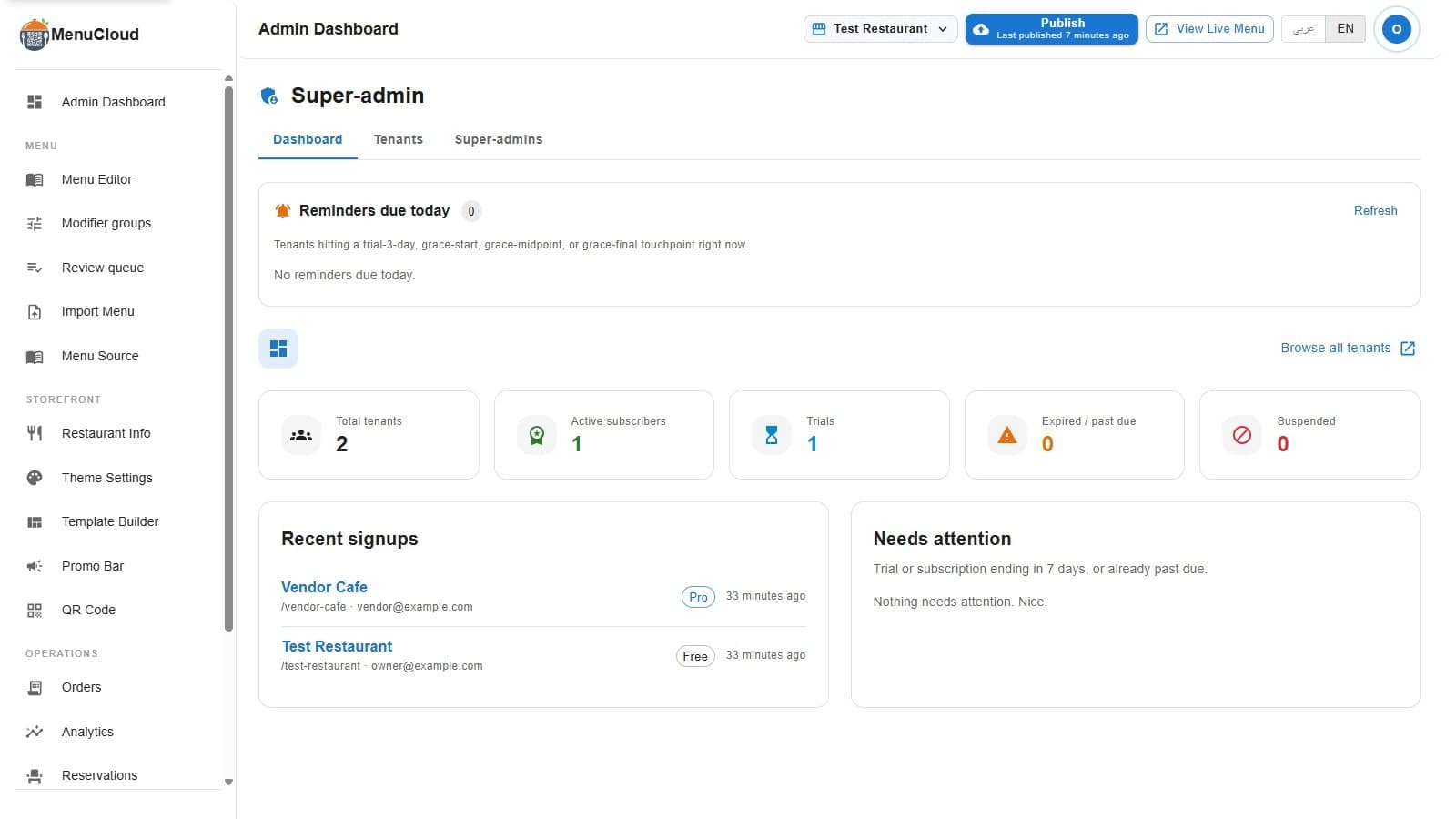
Every admin page carries a small picker in the header showing the name of whichever location you're currently working in, with a "Primary" chip on the original account. Click it and a dropdown lists every branch tied to your account. Pick one and the dashboard reloads into that branch's own menu, orders, and settings. There's a "Manage branches" link at the bottom of that same dropdown, but it's owner-only. A manager invited to one branch sees that branch and nothing past it.
Adding location number two, or number twenty
The full list lives at Manage Branches. Each row shows a location's name, its own public URL, whether it runs the template menu or a PDF, and when it was added. An "Add Branch" button opens a short form: a name, an auto-generated slug you can edit, and a "Copy menu from" dropdown that clones the categories and items of any existing branch instead of leaving you to start from a blank menu. That dropdown is the whole answer to setting up branch three without retyping a hundred items: pick branch one, copy it, then change what's actually different. A chip next to the button tracks how many branches you're using against your limit, and the button disables itself once you hit it.
Pushing one change to every branch at once
Push Update is what turns twenty locations from twenty separate chores into one. Open it from your current branch and there are two checklists: which sections to push (categories, items, theme, restaurant info, promo bar) and which branches receive them. Check theme and select every location for a rebrand in one pass instead of opening each branch's editor by hand. It warns you first, plainly: "This overwrites the selected sections on the targets. Existing items in those sections will be replaced." That matters, because pushing items replaces item data on the destination branches. Use it for changes that should look identical everywhere, and keep location-specific pricing out of what you select.
One team, branch-scoped roles
Team invites carry a branch scope. Assign a manager to one branch and their account is limited to that location's menu, orders, and settings and nothing else tied to the parent account. Team roles and staff permissions covers what owners and managers can each touch in more detail. It's the difference between a shift manager who can fix a typo at their own store and someone who could reach all twenty by mistake.
If you're setting branches up for the first time rather than adding a twentieth, multi-branch restaurant management covers the basics: how a branch relates to the primary account, and what stays shared versus what each branch owns on its own.
What running twenty branches actually costs
Billing stays on the primary account no matter how many branches sit under it. The root location runs 90 EGP a month or 1,000 EGP a year. Every branch after that is half price, 45 EGP a month or 500 EGP a year. Run the math on twenty full locations, one root plus nineteen branches, and it comes to 945 EGP a month, or 10,500 EGP a year, for the whole group under one login and one invoice. Our branch add-on pricing walkthrough goes through when adding a branch is worth it against running separate accounts. New accounts get a 14-day free trial with no card required, which is enough time to build out one location and decide whether the rest of the group belongs on the same dashboard.
Starting with branch two
If you're running one location today and weighing a second, the fastest way to find out whether this fits is to open Manage Branches, add a branch, and copy the menu you already built instead of starting over. You'll know within a few minutes whether the workflow matches how your locations actually differ, and Copy menu from is sitting there in the same dialog every time you open a new one.